For the last decade, hospital digital marketing in India operated on a reasonably predictable playbook: rank for the right keywords, build a blog that answers patient questions, run Google Ads for high-intent procedures, and watch the appointment form fill up. That playbook still works — but there's a structural change happening at the top of Google's search results page that every hospital marketing team needs to understand before their next content budget discussion.
Google's AI Overviews — the AI-generated answer boxes that now appear above organic results for a significant chunk of health-related queries — are answering your patients' questions before they ever reach your website. The patient who used to click through to your "what is a knee replacement" page? Google is answering that question for them now. The click never happens.
This doesn't mean SEO is dead. It means the type of content that earns traffic is shifting dramatically — and hospitals that understand this shift now will widen their lead over those that don't.
What AI Overviews actually are — and aren't
AI Overviews (formerly Search Generative Experience) are Google's way of using its Gemini AI to synthesise an answer to a query directly on the search results page, pulling from multiple sources it deems authoritative. For health queries — symptoms, conditions, procedures, medications — they appear frequently and prominently.
What they are not: a replacement for your website in the eyes of a patient who's ready to book. Someone searching "best orthopaedic hospital in Indore" or "knee replacement cost in Mumbai" is not getting an AI Overview that answers their question — they're getting a local pack and paid ads and organic results. High-intent, transactional queries are largely unaffected. It's the informational layer — the top-of-funnel content that hospitals have invested years building — that is being partially absorbed by AI.
"The content that used to bring patients to your website is now the content Google uses to answer questions without them visiting at all. The strategic response is to build the content Google can't synthesise — trust, specificity, and proof."
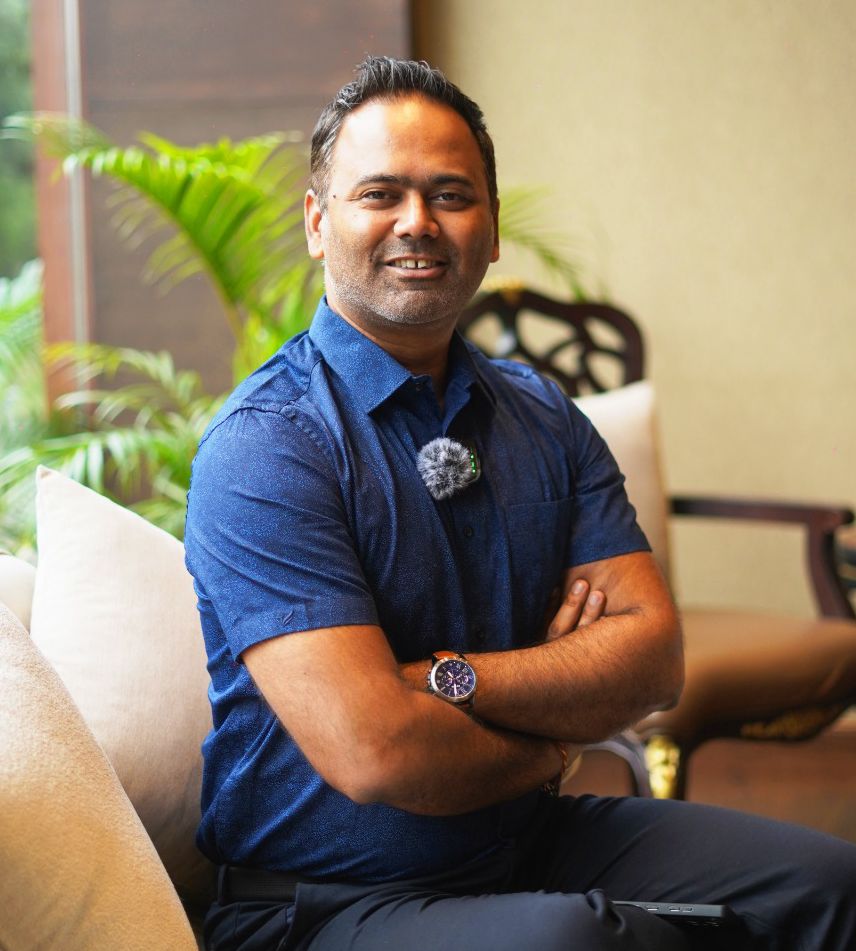
— Manish Vaswani, Fullscoop Digital
What content gets cited inside AI Overviews
Google's AI Overviews do cite sources — and those citations appear as small cards below the AI-generated answer. Being cited inside an Overview is now one of the most valuable positions in health SEO, because it signals that Google's AI trusts your content enough to reference it when answering a patient's question. Here's what our analysis of cited hospital and healthcare sources in India shows:
- Doctor-authored content with visible credentials. Pages that clearly attribute authorship to a named doctor, with their specialisation, registration number, and hospital affiliation, are cited significantly more often than anonymous hospital blog posts. EEAT (Experience, Expertise, Authoritativeness, Trustworthiness) is not a concept — it's the algorithm's hiring criteria for AI Overview sources.
- Structured, specific answers. Content that directly answers a discrete question — "How long is recovery after a laparoscopic cholecystectomy?" — with a clear, evidence-backed answer is more likely to surface than a 2,000-word general guide on the same procedure. AI Overview content extraction favours clarity over comprehensiveness.
- FAQ schema markup. Pages with properly implemented FAQ structured data appear in AI Overview citations at a measurably higher rate. This is one of the most direct technical levers hospital teams have right now.
- Freshness signals. Outdated content — a post about COVID treatment from 2020, a drug dosage page that hasn't been reviewed in three years — is being actively deprioritised. Every medical content page needs a visible "last reviewed by [doctor name]" date.

The queries that still drive real appointments — and how to win them
The anxiety around AI Overviews is mostly concentrated in the wrong place. Hospital marketing teams are worried about their informational blog posts losing traffic — and they will, for some queries. But the queries that actually convert to appointments are largely protected from AI Overview displacement.
Queries like "best cardiac hospital in Pune," "IVF cost Hyderabad," "orthopaedic surgeon near me," "robotic knee replacement India," and "second opinion cancer treatment" — these are not answered by AI Overviews. They trigger local packs, paid ads, and organic results. This is where appointment-driving SEO lives, and it's where hospitals should be directing the majority of their technical and content investment right now.
For these high-intent queries, the fundamentals of local SEO have never mattered more:
- Google Business Profile is now a clinical asset, not a marketing afterthought. Speciality-by-speciality GBP optimisation, consistent NAP data, review management, and Q&A monitoring on your GBP directly influence local pack rankings — which AI Overviews do not displace.
- Procedure-specific landing pages, not general "our services" pages. A page titled "Robotic Knee Replacement Surgery in Indore" with doctor profiles, cost transparency, patient outcomes, and a clear booking path will outperform a generic orthopaedics department page every time.
- Review velocity matters more than review count. Google's local algorithm weighs recency. Ten reviews in the last 90 days beats 200 reviews from three years ago. Build a structured post-discharge review request workflow if you don't have one.
The content strategy pivot: from traffic to trust
Here's the hard truth that most hospital digital teams don't want to hear: the content you wrote to capture informational traffic — the 1,500-word blog post about "symptoms of appendicitis," the FAQ page about "what to expect during an MRI" — that content's job description has changed. It no longer primarily exists to drive traffic. It now exists to earn authority signals that influence how Google perceives your entire website.
The hospitals that will come out ahead in the AI Overview era are those that rebuild their content strategy around a different metric: citation-worthiness. Content that a doctor would actually stand behind. Content that is specific enough to be definitively useful. Content that is updated regularly enough to reflect current clinical guidelines.
| Content Type | Impact of AI Overviews | Strategic Priority |
|---|---|---|
| General condition/symptom guides | High displacement — AI answers these directly | Rebuild for citation quality, not traffic volume |
| Procedure-specific landing pages | Low displacement — intent too transactional | Top priority — invest heavily here |
| Doctor profile pages | Zero displacement — personal, unreplicable | Critical — rich, credentialled, updated |
| FAQ schema pages | Opportunity — highest citation rate in Overviews | Build for every major procedure and condition |
| Cost & pricing transparency pages | Low displacement — AI won't quote your prices | High-converting, underused by most hospitals |
| Patient testimonial / outcome pages | Zero displacement — social proof AI can't generate | Invest in video testimonials, outcome data |
| Generic hospital blog posts | High displacement | Deprioritise unless written by credentialled doctors |
The EEAT imperative — and why healthcare is ground zero
Google's EEAT framework — Experience, Expertise, Authoritativeness, Trustworthiness — was introduced as a quality rater guideline years ago. For healthcare content, it has always been weighted more heavily than any other vertical. Google classifies health queries as YMYL (Your Money or Your Life) — meaning the algorithm applies higher scrutiny to what it ranks and cites.
AI Overviews have amplified this further. The sources Google's AI cites for health information are almost exclusively those that demonstrate:
- Real medical expertise — named authors with verifiable credentials, not hospital marketing departments writing anonymously
- Institutional authority — NABH-accredited hospitals, teaching hospitals affiliated with medical universities, specialists with published research or public profiles
- Review and recency — content that is demonstrably kept current, with visible review dates and update histories
- Source citations — health content that links to clinical guidelines, journal references, or government health advisories is treated as more authoritative than content that makes claims without references
We audit and rebuild hospital SEO strategies for the AI era.
Content architecture, EEAT signals, local SEO, schema markup — one team, one strategy.
What hospital marketing teams should do in the next 90 days
Knowing about AI Overviews is one thing. Knowing what to actually change is another. Here's the sequenced action plan we're running for hospital clients right now:
- Audit your top 50 informational pages for EEAT signals. Does each page have a named doctor author? Are credentials displayed? Is there a "last reviewed" date? Is the content referenced against current guidelines? Score each page and prioritise the highest-traffic ones for immediate upgrade.
- Implement FAQ schema on every procedure and condition page. This is the single highest-return technical task for AI Overview citation probability. It's also the most neglected schema type across Indian hospital websites.
- Build or rebuild your doctor profile pages. A doctor profile page with their qualifications, specialisation, published work, photo, video, and a list of conditions they treat is one of the most powerful EEAT signals you can build. Most Indian hospital websites have a name and a two-line bio.
- Create cost and pricing transparency pages. "Knee replacement cost in [City]" is a high-intent query that AI Overviews do not answer — because the answer is hospital-specific. These pages convert. Almost no hospital in India builds them well.
- Claim and optimise your Google Business Profile by speciality. If your hospital has multiple departments or campuses, each should have its own GBP entry, fully optimised with services, photos, reviews, and Q&A managed actively.
We've built digital strategies for hospitals across India for 14+ years.
Let's talk about what needs to change on your website — and what's already working.